From AEO to CRO: The B2B marketing tactics that matter now

Key takeaways
- AI has moved B2B discovery off your website and into communities, review sites, and AI tools
- Most marketing programs focus on the top of the funnel, leaving buyers stranded when it’s time to decide
- The teams winning right now are treating discovery to conversion as one system, focusing on 11 connected tactics to drive results
Don’t worry, we’re all feeling it
As marketers, we live by certain constants: Know your audience. Differentiate from the competition. Prove your ROI.
But the ground beneath those principles is shifting. According to HubSpot, 61% of marketers believe that marketing is experiencing its biggest disruption in 20 years due to AI.
We’ve all felt the effects. “Tried-and-true” approaches aren’t working the same. There’s more noise, newer channels, bigger expectations, faster turnarounds. Today’s buyers are using AI to do research and form opinions before we can even reach them.
The good news is that it’s not too late to catch up.
In this post, you’ll learn:
- Why the traditional buying journey no longer applies
- How AI has thrown a wrench in most common marketing approaches
- How to update your B2B marketing strategy for the AI era
Let’s get into it.
AI has entered the chat
It’s more than a buzzword, or the reason your uncle posts weird videos on Facebook. Research shows that AI has fundamentally changed the buying process.
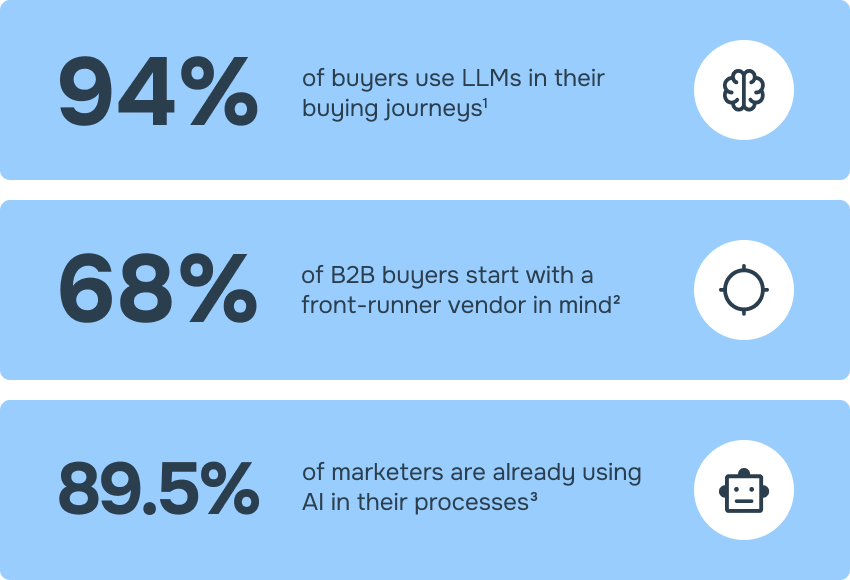
Until recently, it was assumed that the first place a buyer might learn about your business was your website. Not anymore. Now buyers are arriving after already scoping you out elsewhere. Your website has moved from the top of the marketing funnel to the middle.
More on that “funnel”: it’s never really been as linear as it sounds. And as more buyers use more AI, their journeys will become even less linear, with audiences coming in through multiple entry points and bouncing around freely before deciding.
As marketers, we now have two audiences to serve: the humans making buying decisions, and the AI tools making recommendations to them. The goal is to show up for both before buyers reach you, and be ready to convert them when they arrive.
They’re researching you right now. Are you showing up?
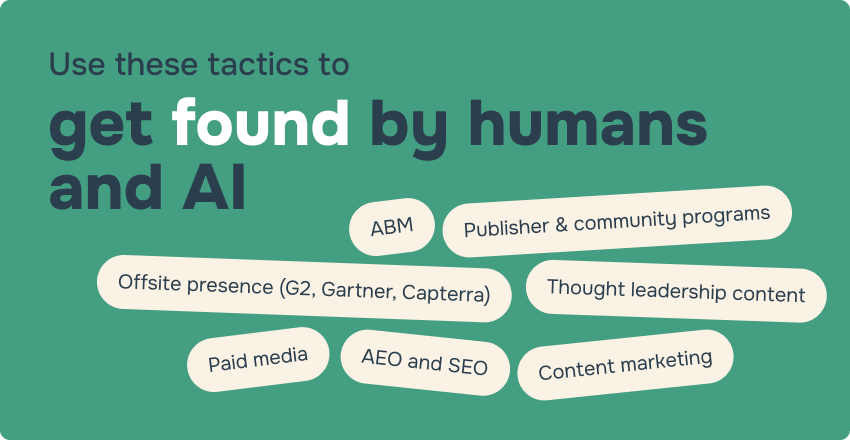
Getting discovered used to mean ranking on page one of Google. That's still part of it, but only part. Today's buyers are forming opinions about you via AI answers, peer communities, review sites, and thought leadership content long before they visit your site.
7 tactics for getting discovered
Here are the top-of-funnel B2B marketing tactics that matter the most right now.
Publisher and community programs
What’s changed: More buyers (and crawlers) are turning to publications, Slack, Reddit, and events to get intel. According to SurveyMonkey, 55% of B2B decision-makers say they struggle to know which information sources to trust — so they turn to people with nothing to sell. 73% of those decision-makers also say peer reviews are their most trusted source of information, ranking above vendor websites and search engines.
The same qualities that make those publisher and community programs valuable to humans also make them useful to LLMs. AI tools are designed to surface credible, unbiased signals. These programs have the architecture LLMs reward: organic discussion, diverse perspectives, and content that’s not packed with marketing buzzwords.
How to excel: Meet your buyers where they already are! The best way to come up in a conversation is to join it yourself. Find the publications, forums, Slack channels, and events where your audience gathers, and build a presence as an active contributor.
Thought leadership content
What’s changed: AI has flooded the conversation with noise and just-believable-enough content. So buyers are gravitating toward voices that are harder to fake: executives with unique points of view, original research, and analyst perspectives that reflect human expertise.
The stakes are higher than most marketers realize. According to Edelman, 73% of B2B decision-makers say thought leadership is more trustworthy for assessing a vendor's capabilities than its actual marketing materials.
How to excel: Make your authority known on outlets like LinkedIn. Don’t be afraid to challenge buyers’ assumptions. Point out new risks or opportunities that aren’t being discussed yet. And keep your content fresh: Recency plays a big part in what AI models decide to cite.
Offsite presence
What’s changed: AI has flipped the script for resources like G2, Gartner, Capterra, and industry directories in surprising ways. While these sites have always been important for humans doing their homework, they’ve lost 90%(!) of their direct traffic (from humans). According to SE Ranking, they’re now essential in a different way — as a crucial source of structured product information, reviews, and feature comparisons for LLMs.
That makes a big difference when half of today’s B2B software buyers are starting their research with AI chatbots. According to G2, nearly half of buyers say citations from software review sites are the most confidence-inspiring signal in an AI-generated response.
How to excel: Get on there. (Noticing a pattern?) If you’re already on these sites, make sure that you’ve claimed your profile, and that your messaging is current and consistent. Having an account won’t make a difference if your information is incorrect, or if you’re listed in the wrong category.
AEO and SEO
What’s changed: Google’s still important, but now it’s part of a much bigger game. Today’s buyers are using tools like ChatGPT and Perplexity to research vendors, compare options, and build shortlists. According to Loganix, 73% of B2B buyers now use AI in their research process.
The challenge is, buyers can get completely different results depending on how and where they search. According to the same Loganix report, ChatGPT shows only a 6.5% URL overlap with Google's top 10 results. Two out of three AI citations come from content that wouldn't even appear on the first page of a Google search.
How to excel: Along with your SEO programs, take the time to understand how different AI engines decide what to cite. Make sure you show up in the sources that matter for your audience, including the communities and websites mentioned in this post. Beyond that, structure your content to make it more AI-friendly. Jargon incoming: Things like schema markup, entity consistency, and content recency signals make a big difference in getting cited. Tools like Webflow and Profound can help with these efforts, automating the technical work and monitoring whether it’s paying off.
Content marketing
What’s changed: Content gaps have become a bigger liability. Now that your audience has tripled to include humans, LLMs, and AI agents, any question you don’t answer yourself is more likely to be answered by a competitor with a smarter content plan. That’s a major concern in a time when 42% of marketers admit they’re missing content for key stages.
The format of your content matters too. AI loves to cite original data and long-form structured content. According to AirOps, the sweet spot is 500 to 2,000 words, with one focused topic vs. a breadth of points. Webinars are also effective, especially for their derivative content that can generate transcripts, clips, blog posts, social content, and buyer intent data.
How to excel: Start with an audit that identifies where your content leaves questions unanswered. Then build fuller content marketing programs that meet buyers at every stage of their needs, in a format that can be digested by both humans and AI tools.
Paid media
What’s changed: Today’s paid media programs have a spray-and-pray problem. According to eMarketer, even as B2B ad budgets grow, over half of marketers identified waste as a major concern, with 52.4% of them estimating losses between 16% and 45% of their total budget.
Meanwhile, as discussed in this blog, those buyers are spread across a much more fragmented channel mix. And with today’s shrinking budgets and workforce challenges, it’s tougher than ever to reach the right buyers on the right channel at the right moment.
How to excel: Think signal-driven media. Use richer behavioral and layered intent data from multiple sources to identify accounts that are actively searching, then reach them before your competitor does. Tools like Clay allow you to surface signals from unstructured data and use them to refine your audiences and improve performance across channels.
ABM
What’s changed: Traditional ABM used to be about targeting a list of named accounts and reaching the right decision-maker. Now it’s about identifying and influencing entire buying groups who actually make the decisions.
According to Forrester, the typical buying decision now includes 13 internal stakeholders and nine external influencers, with that number rising for more complex or strategic purchases. Everyone brings their own priorities and questions, self-directing their research across communities, review sites, AI tools, and peer networks long before they reach out directly for more information.
How to excel: Build programs that engage the full buying committee. Map the personas involved in a typical deal, segmenting accounts into 1:1 and 1:few tiers, and develop content and messaging relevant to each. Today’s AI-powered data and orchestration tools make this far more data-driven, scalable, and precise than it used to be, moving beyond the limits of earlier ABM platforms to help you identify buying group members, personalize outreach, and coordinate messaging across channels.
Getting buyers to the door is only half the job
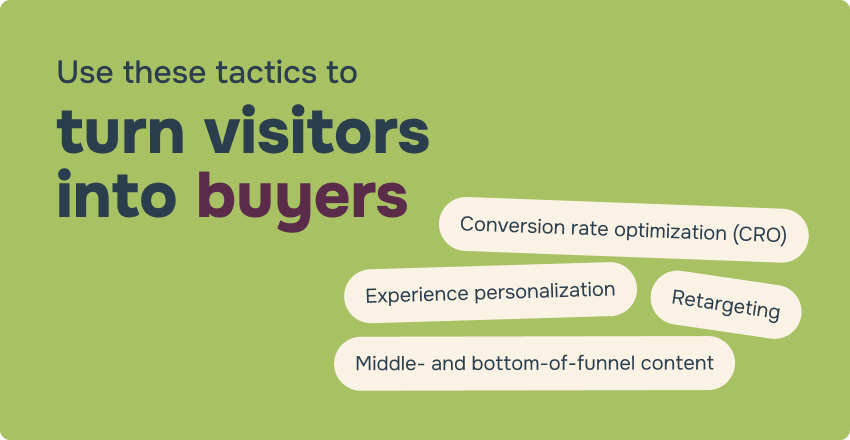
For years, marketers have been narrowly focused on top-of-funnel discovery. But all that work goes to waste without actual conversion.
Today's buyers arrive already educated, already comparing, already leaning somewhere.
The question is whether your on-domain experience will give them the self-serve experience they want, or send them packing to someone else.
4 tactics for getting chosen
Here's how to break your catch-and-release cycle.
Conversion rate optimization (CRO)
What’s changed: Since buyers are arriving at your site already informed, the smallest amount of friction can end the conversation completely. A confusing pricing page, buried link, or form that asks for too much too soon can mean the difference between a conversion and a lost customer.
The tools to fix this have caught up. AI-powered testing platforms can do the work that used to require big teams and big budgets — running experiments, identifying friction points, and continually optimizing.
How to excel: Treat CRO as an ongoing program, not a one-time fix. The buyers arriving on your site today aren’t the same as the ones who arrived last week, and their needs will keep evolving in the future. Use modern tools to build an experiment roadmap and continue testing, adapting, and optimizing to keep up with that moving target.
Experience personalization
What’s changed: Today’s B2B buyers expect the same relevant experiences they get online everywhere else. While the technology to deliver that experience has arrived, 48% of marketers admit they still have little to no website personalization.
The key is to provide personalization that’s actually meaningful, by account, persona, industry, and journey stage level. According to Gartner, 53% of buyers said poor personalization actually harmed their purchase experience(!), while buyers who received helpful personalization were 2.3 times more likely to complete their purchase.
How to excel: Go beyond “Hi [first name].” Real personalization adapts content, journeys, and offers based on account, behavior, and stage. Rather than bogging down buyers with junk they don’t want, carefully provide what they need without making them search for it.
Retargeting
What’s changed: With all the increased noise, buyers are quicker to tune out from irrelevant ads. That’s bad news for most retargeting programs, which typically follow a buyer around with the same ad with the hopes that they’ll eventually convert. That repetition ends up losing leads and wasting money.
The opportunity is to treat retargeting as a continuation of the conversation instead of a replay. When a buyer downloads a piece of content, attends a webinar, or visits a page, that behavior is a signal you can reflect with what you serve them next.
How to excel: Use AI-enabled workflows to orchestrate your retargeting programs across channels. One activity should trigger relevant messaging across others, progressing along with the buyer instead of restarting the conversation from scratch.
Middle- and bottom-of-funnel content
What’s changed: Since most content programs are heavily weighted toward the top of the funnel, marketers are missing the buyers who’ve already done that research themselves. By the time buyers are evaluating solutions, they come prepared with a list of tough questions.
Today’s leading marketers are meeting their buyers’ needs by preemptively publishing the right answers for humans, LLMs, and AI agents. High-performing content dives into questions about ROI, implementation, competitors, and case studies before buyers find those answers elsewhere.
How to excel: Build the middle- and bottom-of-funnel content that meets buyers where they decide. The goal is to provide the right information to take buyers from interest to confidence without requiring a call or email to get there.
The key is connecting the dots
That’s a lot of change, and a lot to prioritize. The good news is that you probably don’t need to start from scratch.
Most teams already have at least some of the right pieces in place. The opportunity is to connect them. Discovery and conversion, brand and demand — it should all come together as one integrated system.
That way, the same technology that’s disrupting your old processes can also help you build a stronger engine for the future.