The 2027 CRO and personalization guide
Today’s B2B buyers do research on their own, checking out your website long before they interact with a rep. This up-to-date guide will help you keep up with those buyers’ ever-increasing expectations.
Below, you’ll find up-to-date ten plays for turning your website into a growth engine. Each one uses the tools you already have so you can quickly start boosting conversions.
Let’s dive in.
B2B website personalization meets buyers where they are
Personalization isn’t just about using your buyer’s name or company in an email. It’s a way to give them an experience tailored to their needs and concerns at a specific moment in their buying journey.
It’s also about having the flexibility to represent your brand accurately to different audiences. If you’re marketing to professionals in two industries, you can personalize a page to speak directly to each audience, rather than having to dilute your messaging or create multiple versions manually.
Specific messaging, focused content, and consistency across channels all help buyers on their journey. Ultimately, personalization keeps them engaged and moving toward conversion while validating that they’re in the right place with the right business.
The difference between CRO and personalization
Conversion rate optimization (CRO) compares different versions of a site to see what works better. Personalization adjusts the site to meet specific visitors’ needs.
Most B2B teams treat them as separate workstreams, but that split costs you speed. The plays in this guide tap both CRO and personalization to help you accomplish one goal: moving your prospects closer to a decision.
The data makes the difference
Before you do anything else, take the time to clean up and enrich the data you already have. Your personalization tools are only as good as the information you build them on: Messy, disconnected data results in generic, irrelevant experiences.
At Iron Horse, we like using Clay to build stronger data foundations and activate audiences unique to your business.
Having a good data foundation and connected systems will supercharge your personalization efforts.
How your stack powers personalization
You probably already have many of the tools you need to drive personalization. The key is to layer and connect what you do have to sharpen your data and trigger the right experience automatically.
This layer passes campaign and ad group data through UTM parameters, so your personalization tool can match landing page messaging to the exact ad a visitor clicked.
Your ABM platform surfaces intent signals and the journey stage for a target segment, so your personalization tool knows who's in-market and what stage they're in.
This layer delivers real-time company and contact data to improve data quality for better segmentation.
Your CRM flags the deal stage, stalled opportunities, and new versus returning contacts, so your personalization tool knows whether to serve a nurture path or a direct sales prompt.
This layer tracks lead score, lifecycle stage, and campaign engagement, so your personalization tool can segment visitors by how sales-ready they are.
Your CMS stores content as modular blocks that your personalization tool can swap by segment, and lets marketers edit those variants directly instead of filing a dev ticket.
This layer uses heat maps and tracks where users are getting stuck. This helps you understand your buyers’ actual journey and where CRO and personalization can make it more seamless.
Your personalization tool pulls the signals from every layer above into one audience definition, then serves the matching experience in real time.

Webflow Optimize is our recommended platform for dynamic, AI-driven testing. Unlike old CRO models that require greater traffic volume than B2B teams can provide, Webflow Optimize can determine a result without a traditional 50/50 audience split.
Run experiments like a GTM strategist
To get efficient results, you need a measured, analytical approach. That means being systematic about what goes into an experiment and how you choose what to test.
Identify what's not working and what you’re looking to improve.
Define the outcome you’re aiming to achieve, and why.
Spell out the changes you think will make the desired impact.
Define the tools you’ll use and the specific steps you’ll take.
Identify the metrics that will tell you if the experiment worked.
Questions to ask before running a test
Use our free personalization experiment roadmap template to track and prioritize your own experiments, or use it as a base to create your own tracker.
Get the template →The practices that make B2B personalization work
Keep these tips in mind as you build your own personalization and optimization experiments.
Build specific, focused audiences from firmographic data (industry, company size, revenue), behavioral signals (repeat visits, content type consumed), campaign source and creative, and account-level data pulled from your CRM or marketing automation platform.
Tie every personalized experience to a specific, measurable objective: increasing conversion rate for demo requests, improving engagement time on service pages, or improving ABM campaign performance with more relevant site content.
Don't personalize everything at once. Start with your homepage, solutions and services pages, pricing page, high-traffic landing pages, and case studies.
Review personalizations on a regular cadence. Use what you learn to shape ad creative, nurture sequences, and social content. Templatize and duplicate what's winning.
Prospects are more likely to find your content and experiences actually useful rather than spammy when you’ve personalized based on everything you know about their actual needs, their stage in the buying process, and what you offer.
Ten plays you can try today
Below you’ll find five overarching marketing goals, supported by two personalization plays each. Click each goal to see the plays.
We’ve also included examples featuring ACME, a fictional B2B SaaS company that supports manufacturing businesses. Keep in mind that the beauty of personalization is that it can be personalized to your audience.
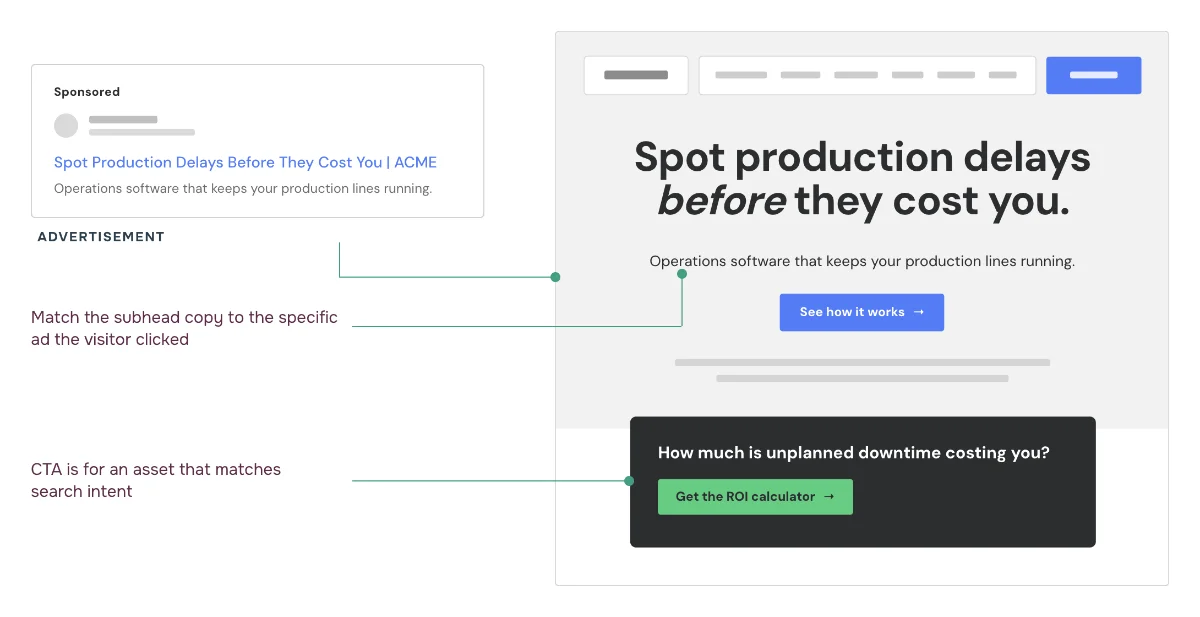
Visitors who click your SEM ads aren’t converting at the pace you expect. The ad copy speaks directly to their needs, but the page they land on fails to echo the message that drew them in. This mismatch prompts them to bounce before reading anything else on the page.
Close the gap by pulling the “ad group” data from your ad tech platform for every visitor. Use your personalization tool to instantly update the corresponding landing page headline to echo the exact messaging of that ad group. If your landing page pushes visitors to a hero asset, you can also swap it to match audience interest.
- Bounce rate reduction from paid media traffic
- Conversion rate lift from personalized pages versus default
- Increase in time on page or scroll depth
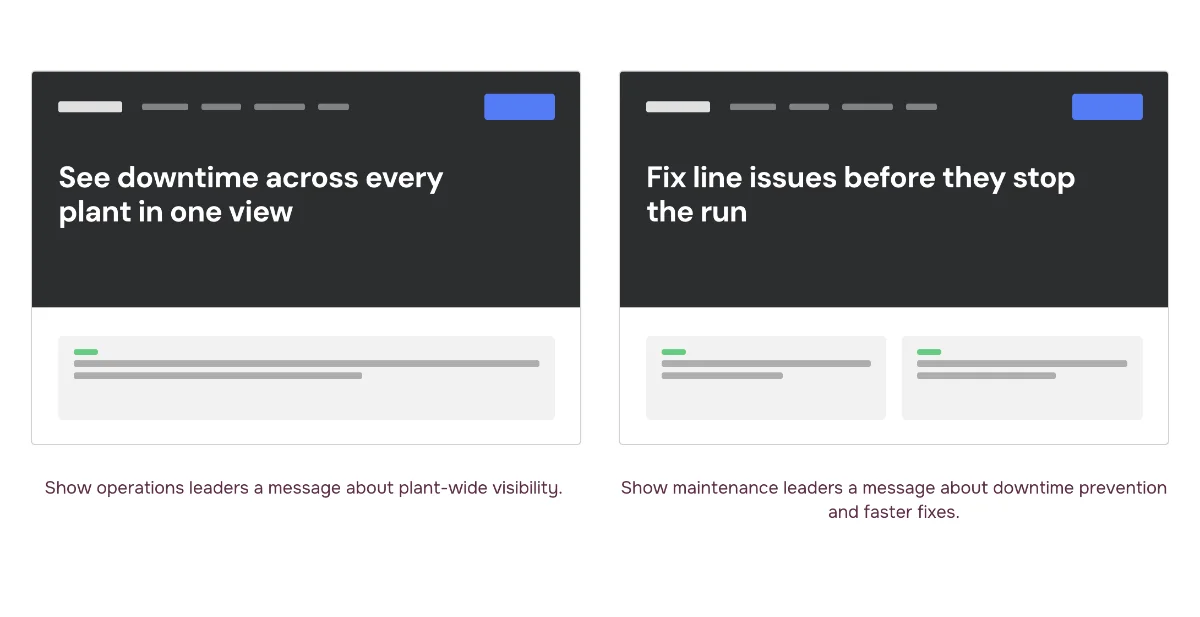
Target account lists often include multiple personas — like a CFO and a technical buyer — who need to hear different things. One generic page speaks to neither persona well, and you undersell your fit to both, costing you conversions.
Use UTM parameters in your ad campaigns to create persona-specific variations of the same page. Building separate CRM lists per persona is often too cumbersome, so UTM-based differentiation gets you persona-level personalization faster.
- Views and time on page by persona
- Form fill rate by persona
Track the better-converting persona variation to guide where you invest next.
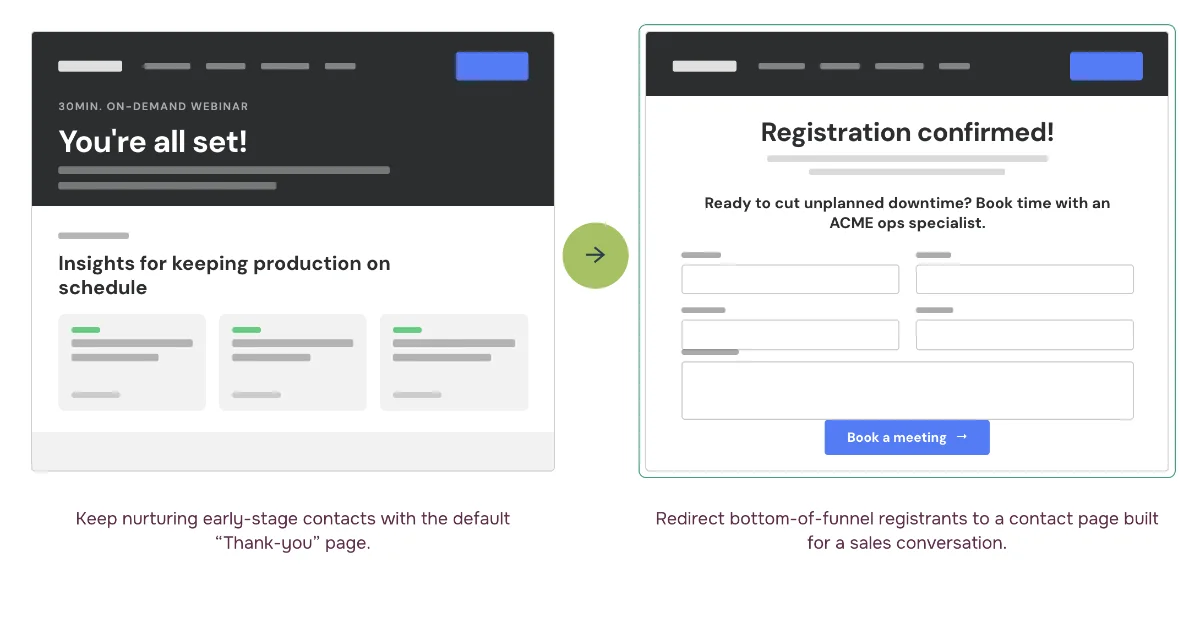
You're losing opportunities to move high-intent prospects forward by treating every webinar registration the same, no matter where the contact actually sits in the buying process. Bottom-of-funnel prospects sign up and land on the same thank-you page as early-stage contacts, a missed moment to move them into a sales conversation.
Use your ABM platform to identify each webinar registrant's journey stage. Use your personalization tool to redirect bottom-of-funnel contacts from the standard confirmation page to a "Contact us" page built to encourage direct engagement with your sales team. For everyone else, keep the default thank-you page with related resources.
- Increase in contact form submissions
- Increase in sales-qualified meetings
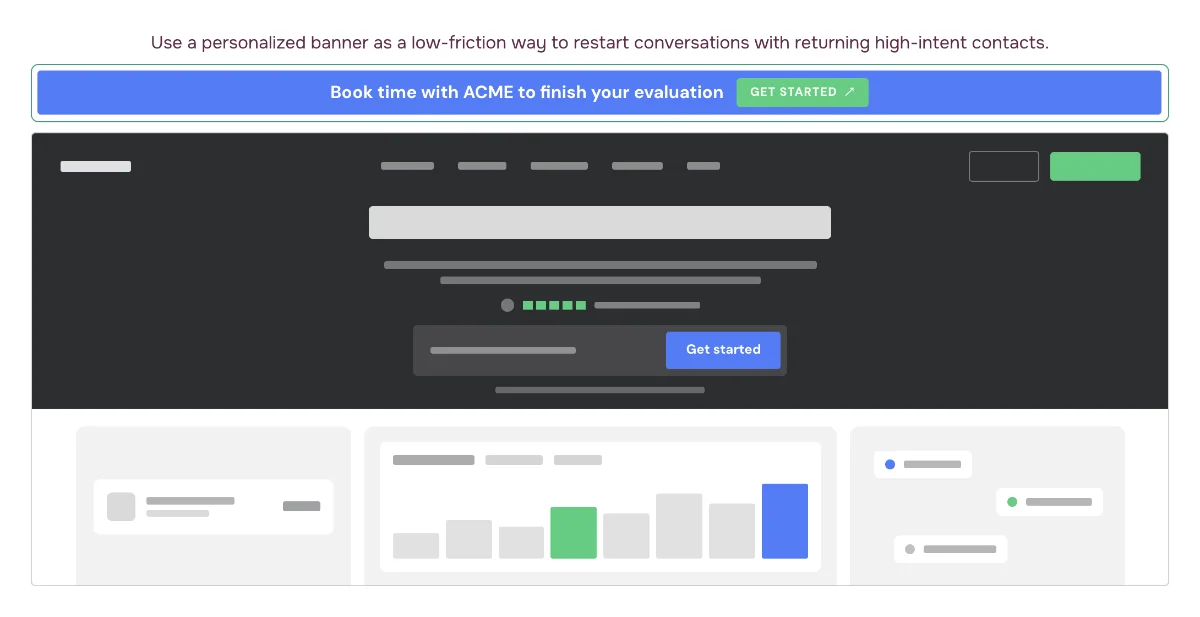
Late-stage opportunities stall because key decision makers go quiet. They return to your site but browse anonymously, giving you no clear signal to reengage. Your current nurture path is passive and misses the chance to restart momentum.
Use your CRM to identify stalled opportunities (for example, open opportunities older than 30 days with no recent activity). Use your personalization tool to flag whether a site visitor is new or returning. When someone from one of these stalled accounts returns, serve a personalized banner with a direct call to action.
- Increase in reactivation rate for stalled opportunities
- Increase in account velocity to the next stage
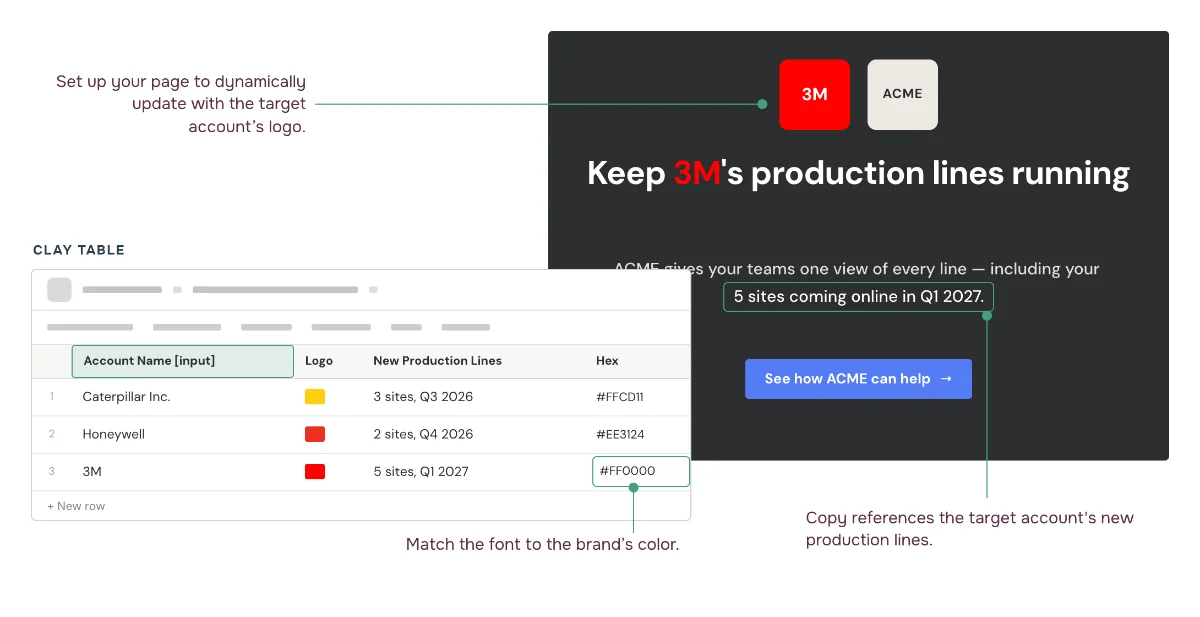
You're driving traffic to your landing pages, but key target accounts leave quickly and take no action because the experience offers little relevance or immediate value. You need to prove your message was built specifically for them.
Tap your sales intelligence platform to pull account data: company logo, brand color, existing tech stack, and inferred needs or current solution. Use your CMS to generate personalized URLs that pull those attributes into the page automatically.
- Increase in average time on page
- Increase in demo requests from target accounts
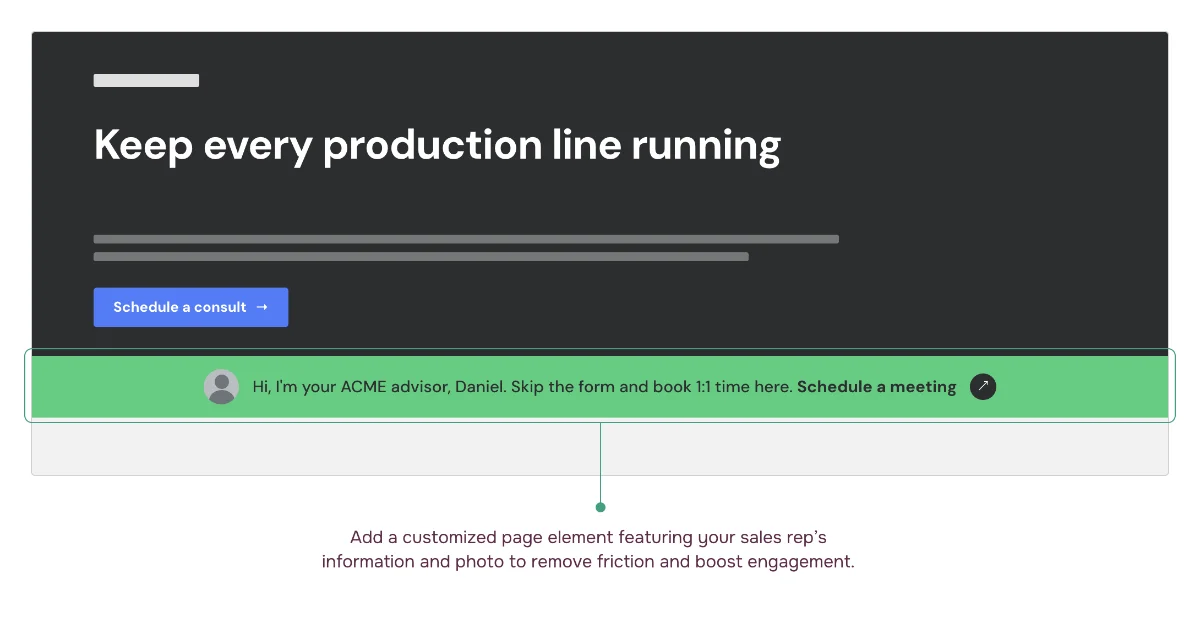
Your sales team is struggling to engage prospects because your standard contact form doesn’t allow for direct scheduling with the right rep. Prospects can be hesitant to fill out yet another form, and delayed responses or protracted scheduling back and forth leads to disengagement and missed opportunities.
Use your personalization tool to create dedicated landing pages for each sales rep, with their photo, name, and a unique “Book a meeting” link tied directly to their calendar. Give each rep this PURL to share in emails and social outreach, offering a better way to connect directly and schedule meetings.
- Increase in meeting bookings or conversions from outreach emails
- Improvement in lead response time
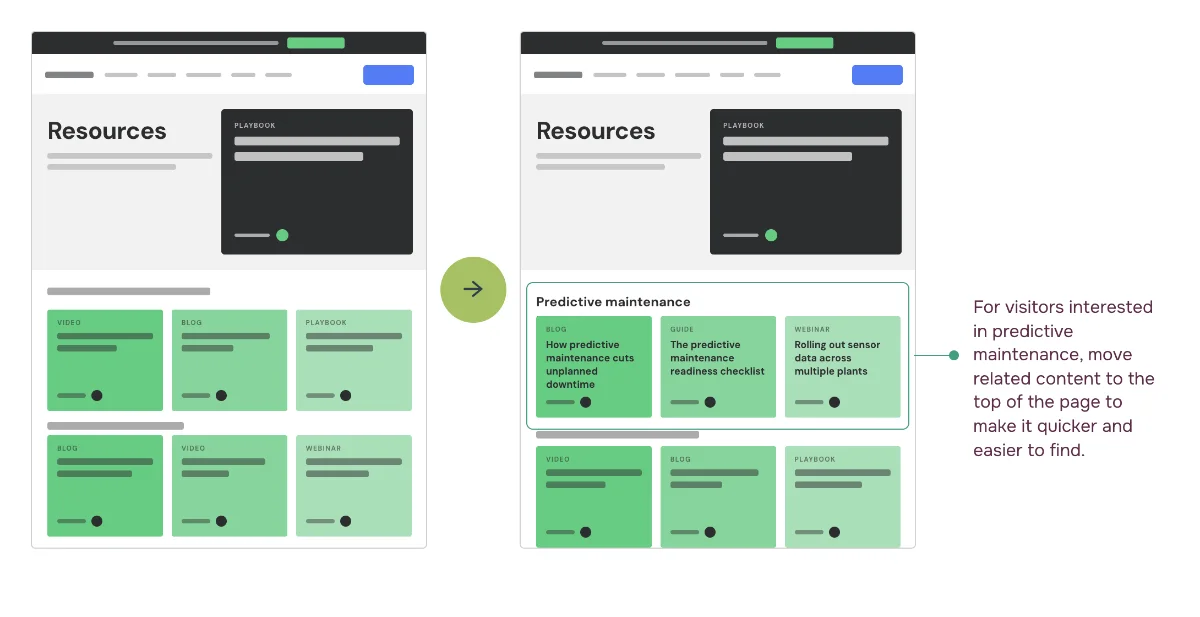
Your resource page isn't driving engagement with the content that matters. Accounts don't access the resources most relevant to their interests, or only find them after digging, and miss out on content that could lead to more conversions.
Using your ABM platform, build a targeted segment of accounts showing intent for a term that aligns with one of your content tags. When those accounts visit your resource center, surface resources on that topic first, instead of the default order.
- Increase in content engagement (views, downloads, time spent on relevant resources)
- Improvement in content consumption behavior, like more relevant resources viewed per visit
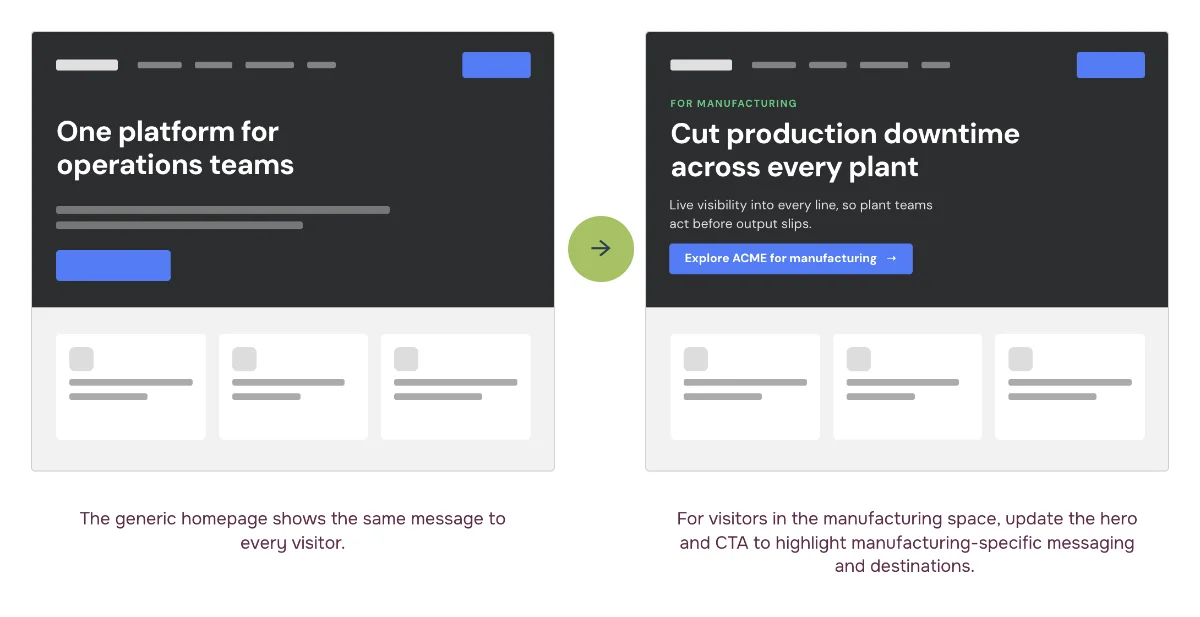
Your homepage is optimized for AEO and SEO, but visitors often don't make it to the right industry-specific page. They land on a generic homepage that lacks context and leave before seeing the message that speaks to their needs.
Use your personalization tool to identify a visitor’s industry — for instance, manufacturing. As they arrive, dynamically swap the hero content for manufacturing-specific messaging. Use the CTA to drive them to the manufacturing industry page, where you can use a pop-up to route them directly to a manufacturing case study.
- Time on page and engagement
- Base homepage versus industry-specific copy
- Completion rate through the full pathway, homepage to industry page to case study
- Key on-page events by industry segment
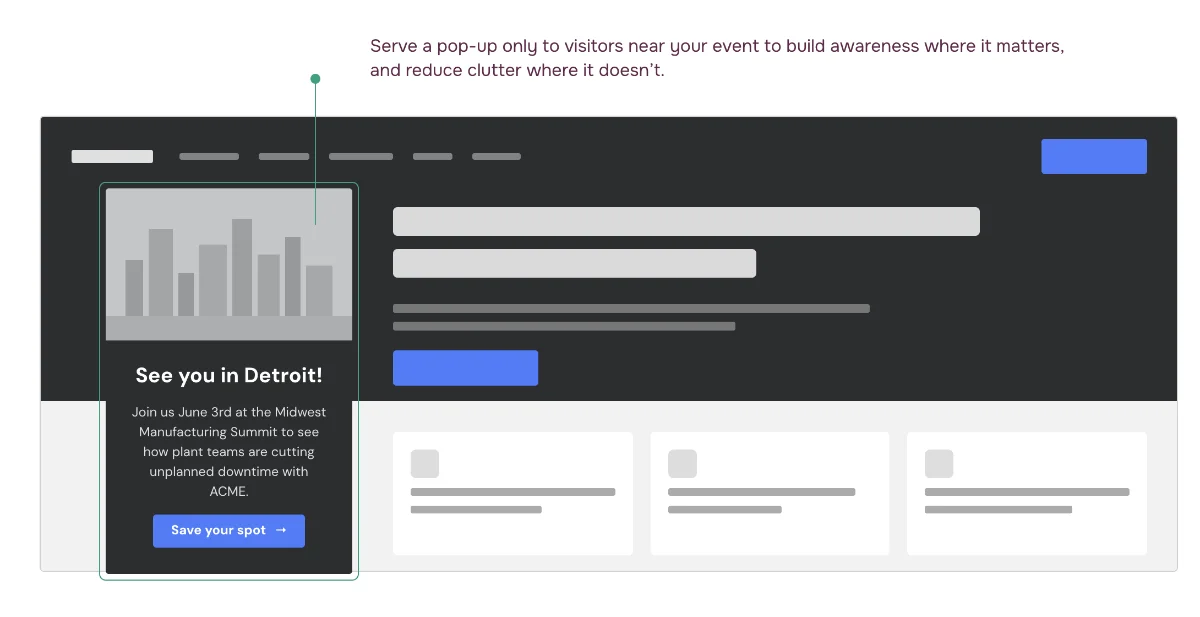
Promoting regional events means a tradeoff: feature the event prominently everywhere and show it to visitors far outside the target region, or limit promotion to the events page and risk your local target accounts never seeing it.
Use your personalization tool to identify site visitors from a specific city in your target area, and serve a personalized popup to visitors from that city. This tailors the promotion precisely to the right accounts without cluttering the experience for anyone else.
- Increase in registration rate from target accounts in the event region
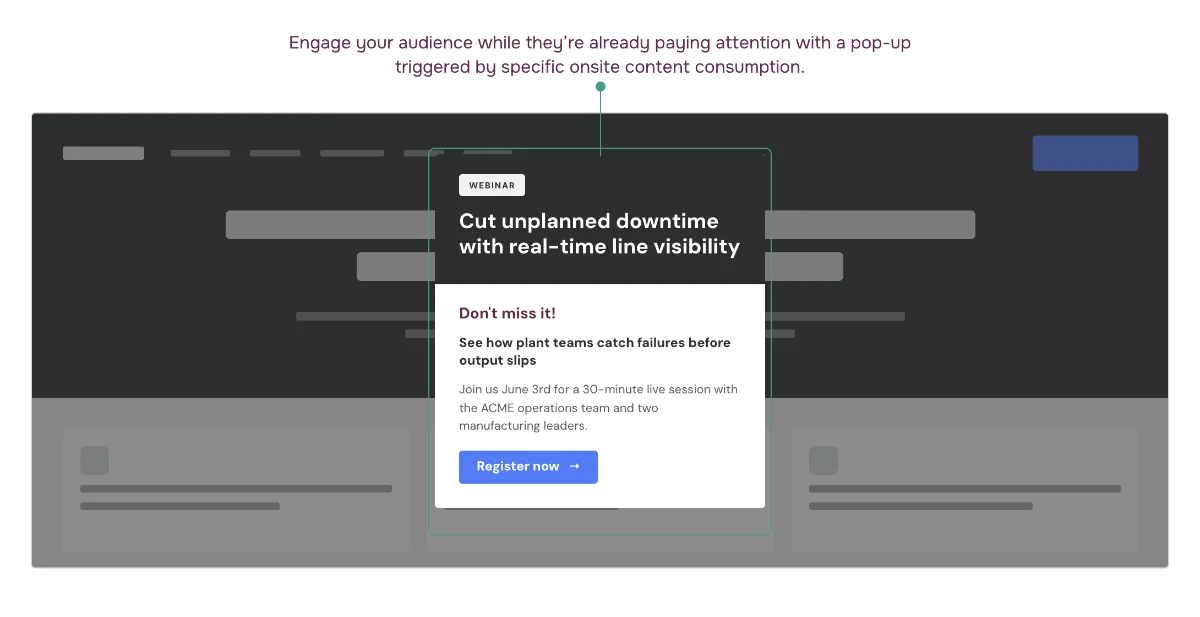
Some of your highest-intent accounts engage with relevant content, blog posts, case studies, product pages, but don't convert on your event registration forms. Without a timely nudge, they slip through.
Use behavioral data from your personalization tool to trigger an exit-intent modal promoting your upcoming event. When a visitor from your target account list views key content and starts to leave, display a personalized message with a call to action to register.
- Exit-intent modal click-through rate
- Registration conversion rate from the modal
Turn your website into a growth engine

Iron Horse is a B2B growth marketing agency that combines digital marketing expertise, a growth hacker ethos, and strategic use of AI to help companies get discovered and get chosen. See what’s possible at www.ironhorse.io.

Webflow is a Website Experience Platform that empowers modern marketers to visually build, manage, and optimize stunning websites, helping them drive higher conversion rates and measurable growth. Learn more at www.webflow.com.